In the Yucatan, the women known as Las Vecinas find economic opportunity and a connection to Mayan culture with stingless bees
By
-
Humberto Basilio

© WWF-US / Alejandro Prieto
In the middle of a garden filled with citrus trees in Yucatán, Mexico, Berta Silvia Canul Díaz built a sanctuary teeming with life. The scent of orange, grapefruit, and lemon travels through the green leaves and the branches that support them. In the center of the garden, a small stone path leads to a palapa (open-sided dwelling) with a thatched roof and mesh and wood walls.

© WWF-US/Alejandro Prieto
Inside the palapa, Canul Díaz lifts one of 30 wooden boxes and places it on a table. Once opened, hundreds of bees emerge from a honeycomb and surround Canul Díaz. “Without bees, there would be no life,” she says, moving delicately among them. “If they disappear, we will too.”
The palapa serves as a meliponary—location to raise stingless bees. It was built by Canul Díaz and five other women from the community of Tzucacab five years ago. Meliponiculture is an ancestral practice of the Mayan culture—one of the most advanced civilizations in Mesoamerica between 250 and 900 AD. Meliponiculturists master the care of meliponines, or stingless bees, from which the technique derives its name. For Canul Díaz and the group known as “Las Vecinas” (The Neighbors), meliponiculture is a major economic activity as they sell honey and related bee products in Yucatán.

© WWF-US / Alejandro Prieto
They named themselves “Las Vecinas” because they all live near the Alicia Díaz Barbosa Cultural Center, where the garden and the meliponary are located. The equipment “is something wonderful,” says Canul Díaz, living proof that “women can do a lot with a little.”
Las Vecinas didn't become bee experts overnight. The group began using ancestral Mayan practices, taking fallen logs and dead trees to build the boxes that house the hives, which allow the colony of stingless bees to grow. In recent years, they have taken workshops and training courses to perfect hive care, comb cleaning, and harvesting the honey produced by the bees—whom Canul Díaz affectionately calls “my loves.”
Difficult years
The last few years have not been easy for Las Vecinas and their bees. Pronounced temperature variations in Yucatán have been devastating for the hives.
Two years ago, a heat wave caused the death of six hives, whose combs could not withstand the high temperatures. 2024 was Mexico’s hottest year on record in the country since 1880, with temperatures reaching up to 113°F in Yucatán.
The bees’ death was a major economic loss for Las Vecinas and devastating for their years of work and effort. As for the local environment, what will happen without these pollinators?

© Alejandro Prieto / WWF-US
“It hurts,” says Canul Díaz, her voice breaking. “We want to take care of them so they can continue taking care of us.”
Canul Díaz says with certainty that she knows why the temperature is rising: In southern Mexico, deforestation is growing at an alarming rate. Seen from the sky, what was once a lush, green jungle during her childhood is now a patchy brown expanse of deforested land, expanding every year from the growing livestock and agricultural industries, as well as unplanned urban development.
The lack of trees prevents heat from dissipating, and the excessive use of chemical pesticides contaminates the soil and the flowers that bees pollinate. “That does us a lot of harm,” she says.
How nature-based solutions can help
Meliponiculture has high potential for targeted pollination of local crops, improving fruit quality and increasing production. Unlike other bee species, Melipona beecheii are docile and easy to keep in small meliponaries like the one at Las Vecinas, which reduce the risk of death from environmental changes.
Meliponiculture is an example of what is known as a nature-based solution, in which communities actively care for and restore the environment using nature itself, while generating sustainable income.

© WWF-US / Alejandro Prieto
In Yucatán, Las Vecinas and other groups of producers are supported by JIBIOPUUC – a consortium of municipalities that joined together to support the conservation of the Puuc Biocultural State Reserve. The consortium creates working spaces with community members to listen to their problems and seek sustainable solutions with the support of organizations like WWF and government authorities. While protecting the environment, it seeks to give communities “reasons to stay, to feel proud of their land, and to have adequate livelihoods,” says , says Director Minneth Beatriz Medina García.

© WWF-US / Alejandro Prieto
Herencia Maya: Preserving a Legacy
In May 2026, Herencia Maya, a new Financing for Permanence Project (PFP), was launched in the region. This long-term conservation initiative seeks to protect the biocultural heritage of Yucatán by strengthening and providing ongoing funding for more than 1.4 million acres of protected natural areas in the state of Yucatán.
“Herencia Maya will directly benefit local communities by protecting their livelihoods, ensuring access to water, strengthening resilience to climate change, and promoting sustainable, productive activities such as meliponiculture at Las Vecinas,” says Alejandro Camacho, Biodiversity and Climate Financing Coordinator at WWF-Mexico.
At the entrance to the community’s Cultural Center, Canul Díaz points to a huge mural depicting the face of her mother, Alicia Díaz Barbosa, the woman who bequeathed to Canul Díaz her patience and love for insects plants and animals and in whose honor the space was named. The mural fills the hallway of the center, which was built on land Canul Díaz inherited from her family and is now a meeting place for the women of Tzucacab.
With a touch of melancholy, she recounts that just as her mother left her something so important, she wants to pass on to her 10-year-old grandson some of what she has worked for and learned since she began her career as a meliponiculturist.
“That’s the most important thing,” says Canul Díaz, “so that we never lose all of this…it’s all we have.”
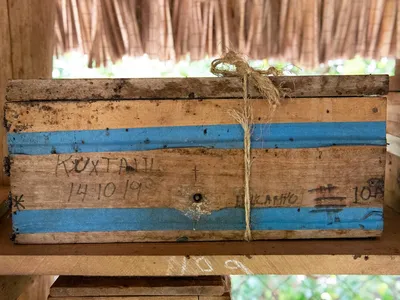
A wood box where Melipona bees produce honey, with a small hole at the bottom that serves as a door and is always guarded by a bee. Each box has its own bee colony. Tzucacab, Yucatán, México
© WWF-US / Alejandro Prieto
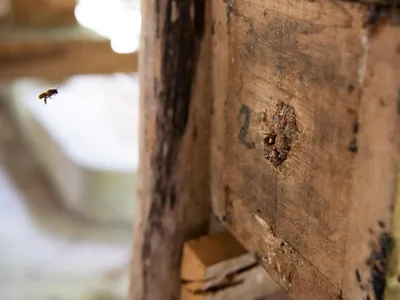
A bee returning home. The guardian bee makes sure that bees from another colony or box don't fly back into the incorrect box. And if an insect tries to enter the box, the guardian bee blocks the hole with wax and creates another small hole.
© WWF-US / Alejandro Prieto
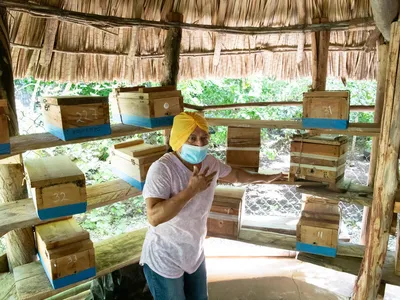
Bertha Silvia Canul Diaz, working inside the Melipona bee boxes. Melipona is a stingless bee species (Melipona beecheii) native to Yucatán, cultivated by the Mayan people for thousands of years. Tzucacab, Yucatán, México.
© Alejandro Prieto / WWF-US
How you can help
© Guy Edwardes/naturepl.com/WWF
Protect nature now
Nature needs your urgent help. Protect the beauty of nature for generations to come.