A brighter future for snow leopards
By
-
Whitney Kent

© Sanjog-Rai DNPWC/WWF-Nepal
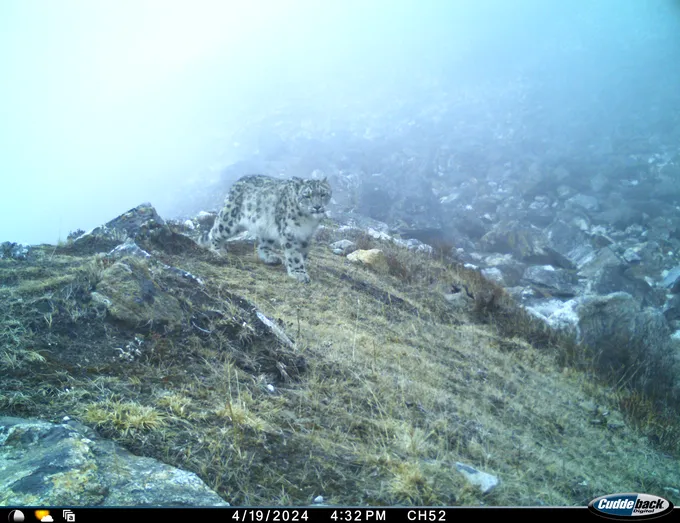
Across 12 Asian countries, snow leopards can be found high in the remote and rugged mountains. Along with their elusive, solitary nature and gray-black camouflaged fur, spotting one of these “ghosts of the mountains” can be extremely difficult, making them one of the least studied big cat species.
In 2025, the release of Nepal’s first robust national estimate of its snow leopard population helped fill in some of these knowledge gaps. The findings indicate a relatively stable population of 397 individual snow leopards in the country—hopeful news for this globally threatened species.
Climate change: one of the greatest long-term threats to snow leopards
Protected and connected habitats are among the most important conservation needs to ensure the future of both Nepal’s and other countries’ snow leopard populations. However, their high-altitude home ranges are becoming increasingly lost and fragmented due to expanding infrastructure development. Climate change is worsening these impacts and driving further decline in snow leopard ranges. As their habitats become less productive and freshwater availability more limited, both snow leopards and the people who also inhabit these areas must move further to find space and resources. This leads to another growing threat: human-wildlife conflict.
Understanding the spatial ecology of these snow leopard individuals, including how they move and use their habitats, will help us better protect them and ensure they have sufficient home ranges to support future populations. This is particularly critical and urgent for snow leopards in the face of a changing climate.
Nepal’s snow leopards may have larger home ranges than we thought
Earlier this year, findings from Nepal’s first GPS telemetry study of snow leopards revealed good news about their home ranges and transboundary movements. GPS data collected from four snow leopard individuals in the Kangchenjunga Conservation Area, one of Nepal’s three priority snow leopard landscapes, found that snow leopard home ranges are significantly larger than previously documented, 6 to 97 times larger than previous estimates in Nepal.* They also found snow leopards frequently crossed international borders, with three individuals crossing into China and India and spending, on average, 10%–34% of their time in these neighboring countries.
These extensive movements across country borders reinforce the need for stronger transboundary coordination between snow leopard range countries to ensure the long-term conservation of snow leopards in this key region of their distributional range.
World’s highest elevation for a snow leopard documented
Another exciting finding from the study: collar data recorded the world's highest elevation for a snow leopard at 19,186 feet above sea level. For the most part, though, the snow leopards preferred areas between 13,000 feet to 16,000 feet, providing more insight into their distributions, prey base and types of habitats they can be found in.
“Nepal’s exemplary efforts in snow leopard conservation are pushing the frontiers of wildlife science and community engagement in the region. As we work to connect habitats across political boundaries, these lessons will be vital in scaling up our ambition for snow leopard conservation,” says Dechen Dorji, vice president for Asia, Wildlife Conservation, at WWF-US.

© DNPWC- WWF Nepal
© DNPWC- WWF Nepal
Nepal’s latest snow leopard research is contributing to the growing knowledge of this understudied big cat species. Through the Greater Himalayan Transboundary Conservation Landscape initiative, Nepal, Bhutan and India are working with WWF and other partners to safeguard and strengthen connectivity across snow leopard habitats. Nepal’s continued commitment to snow leopard conservation will help us secure the future for snow leopards, as well as for the other wildlife species and people they share.
*The large range cited in the study’s results—"from 6 to 97 times larger than previous estimates for Nepal”—reflects the varying home range sizes among the surveyed snow leopards. Data for the individual snow leopards varied in terms of both location frequency and duration. Authors implemented three home range estimators to standardize the data and calculate overall home ranges for the surveyed snow leopards.
How you can help
© WWF-US/Clay Bolt
Support Tribes restore buffalo to the Great Plains
The Indian Buffalo Management Act would strengthen support for Tribal Nations who are working to bring buffalo back from the brink of extinction.