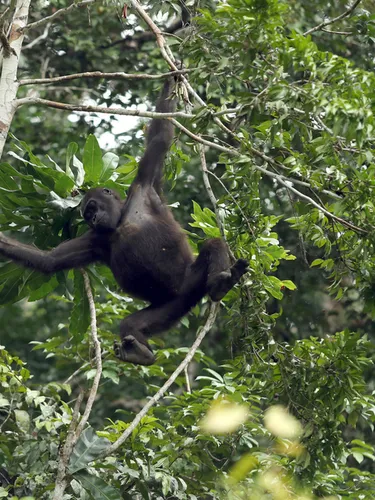
© Gesa Koch-Weser / WWF
Eastern lowland gorillas
The eastern lowland gorilla—also known as Grauer’s gorilla—is the largest of the four gorilla subspecies. It is distinguished from other gorillas by its stocky body, large hands and short muzzle. Despite its size, eastern lowland gorillas subsist mainly on fruit and other herbaceous materials, just like other gorilla subspecies.
Years of civil unrest in the Democratic Republic of Congo (DRC) have taken their toll on both the eastern lowland gorilla and the mountain gorilla. The eastern lowland gorilla makes its home in lowland tropical rainforests in the eastern DRC. In the last 50 years, its range has decreased from 8,100 square miles—about the size of the state of Massachusetts— to about 4,600 square miles today. This subspecies may now occupy only 13% of its historical range. There were nearly 17,000 eastern lowland gorillas in the mid-1990s but scientists estimate that the population has declined by more than 50% since then. An accurate accounting of the animals has been impossible for many years because of violence in the region.
Throughout the unrest, the gorillas have been vulnerable to poaching, even in Kahuzi-Biega National Park, home to the largest population of protected eastern lowland gorillas. Rebels and poachers invaded the park and people set up illegal mines. But, with help from WWF and other organizations, park staff are reestablishing control over the land.
Eastern lowland gorilla facts
- Status Learn more about endangered status categories and explanation
- Critically endangered
- Population
- Unknown
- Scientific name
- Gorilla beringei graueri
- Weight
- up to 440 pounds
- Height
- 4–5 ½ feet tall when standing on two feet
Why eastern lowland gorillas matter
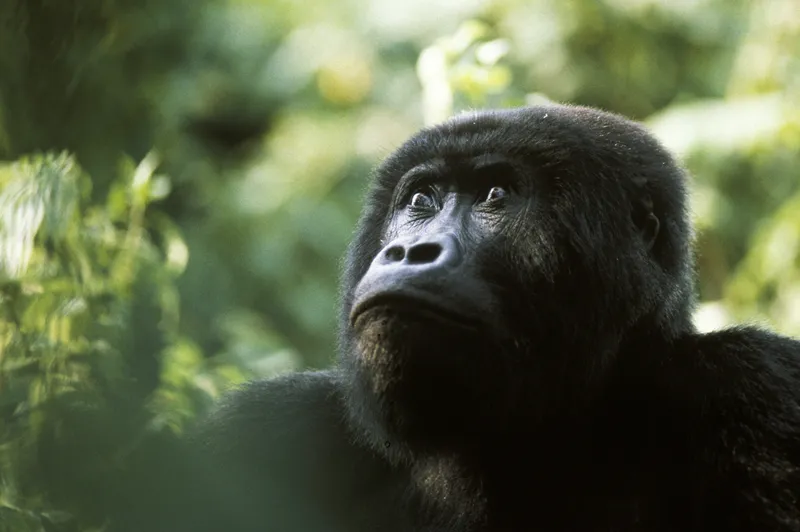
© naturepl.com / Karl Ammann / WWF-Canon
A quickly disappearing subspecies
The eastern lowland gorilla’s range has declined by at least a quarter over the last 50 years. The last census, in the mid-1990s, estimated that there were only 16,900 of the animals left in the wild, but following more than a decade of habitat destruction and fragmentation and years of civil unrest, the eastern lowland gorilla’s population may have declined by half or more.
Threats to eastern lowland gorillas
-
50 percent
Scientists estimate that the population of eastern lowland gorillas has declined by more than 50% since the 1990s when their population numbered 17,000.
Habitat loss and fragmentation
As humans have moved from high-density regions in the East into the gorilla’s territory, they have destroyed and fragmented much of the animal’s forest habitat to make room for farming and livestock. Only a small portion of the gorilla’s range lies in protected areas such as Kahuzi-Biega National Park. But even there, park rangers often find it difficult to patrol the borders and protect the gorillas.
Mining
Illegal mining for tin, gold, diamond and, especially, coltan—an alloy used in cell phones—is widespread throughout the eastern lowland gorilla’s range. This mining has helped to fuel the civil unrest in the region and attracted migrants who hunt the animals for bushmeat, medicine and the capture and trade of infant gorillas.
Civil unrest
Years of political instability and conflict have left the Congolese network of national parks in a state of neglect. Humans have been able to encroach upon Kahuzi-Biega National Park to hunt gorillas and to set up illegal mines. In addition, military activity and the presence of heavy weaponry have contributed to unrest in the region that has made conservation efforts difficult.
Experts

How you can help
© WWF-US / WWFGifts
Adopt a gorilla
Support WWF’s global efforts to protect wild animals and their habitats and choose from kits with plush and more.