© David Hulse / WWF
Saola
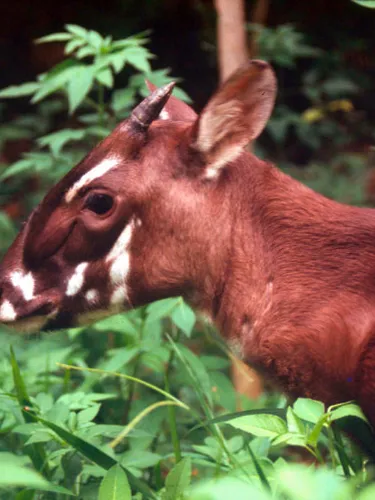
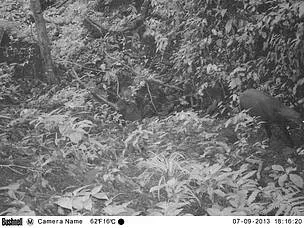
Often called the Asian unicorn, little has been uncovered about the enigmatic saola in the three decades since its scientific discovery. None exist in captivity and this rarely seen mammal is already critically endangered (the last step before extinction). We know saola from several camera trap photographs, a few short-lived captured individuals, and species remains found in villages.
The saola was first documented by scientists in May 1992 during a joint survey carried out by the Ministry of Forestry of Viet Nam and WWF in north-central Viet Nam. The team found a skull with unusual long, straight horns in a hunter's home and knew it was something extraordinary. The find proved to be the first large mammal discovery in more than 50 years, and one of the most spectacular zoological discoveries of the 20th century.
Saola (pronounced: saw-la) are recognized by two parallel horns with sharp ends, which can reach 20 inches in length and are found on both males and females. Meaning “spindle horns” in Lao and a Tai ethnic language in Viet Nam, they are a cousin of cattle but resemble an antelope. Saola have striking white markings on the face and large glands on the muzzle, which may be used to mark their territory or attract mates. They are found only in the Annamite Mountains of Laos and Viet Nam.
Saola facts
- Status Learn more about endangered status categories and explanation
- Critically endangered
- Population
- Unknown
- Scientific name
- Pseudoryx nghetinhensis
- Weight
- 176–220 lbs.
- Height
- About 33 in. at the shoulder
- Habitats
- Evergreen forests with little or no dry season
Why saola matter
© WWF-Viet Nam
Its rarity, distinctiveness, vulnerability, irreplaceability, and cultural significance as an symbol of the Annamite forest for Lao and Viet Nam, coupled with the lack of conservation attention globally make it one of the most critical priorities for conservation in the region. The current population is thought to be only a few hundred at most, and possibly only a few dozen.
Threats to saola
Habitat loss
As forests are cleared to make way for agriculture, plantations, and infrastructure, saola are being squeezed into smaller spaces while human access to their remote habitat increases, bringing people into the once-inaccessible areas where saola are thought to still roam.
Hunting
A 2020 WWF report estimated ~12,000,000 snares are present in the protected areas of Lao, Viet Nam, and Cambodia at any given time. These snares are cheap to make and indiscriminately trap animals as small as mice to as large as elephants, including the saola. Although not necessarily the target, saola are at risk of being bycatch in snares that are set to catch other ground-dwelling species that supply the trade in wild meat and traditional medicine, both domestically and internationally. Growing demand from increasingly wealthy urban populations is driving demand for wild meat and traditional medicines at an unsustainable level, while fragmentation of forests and improved infrastructure are making remote areas more accessible and vulnerable to this hunting and trade.
How WWF is taking action to protect saola

© WWF-US / Justin Mott
WWF has been involved with the protection of the saola since its scientific discovery. We helped improve the management of Vu Quang Nature Reserve where the saola was discovered, and helped establish two new adjacent saola reserves in the Thua-Thien Hue and Quang Nam provinces.
WWF also works on research, improved community-based forest management, capacity building among government and community rangers, preventing poaching, and reducing demand for wildlife products that drive snaring. By collaborating with our local partners as well as other organizations that are committed to conserving the saola and the Annamites, WWF is playing an active role in the international efforts to save this species from extinction.
How you can help
© George Walsh
Strengthen the Endangered Species Act
More than 99% of the species listed under the Endangered Species Act have avoided extinction due to the law’s protections. Today, those protections are under threat — at the exact moment wildlife needs them most.