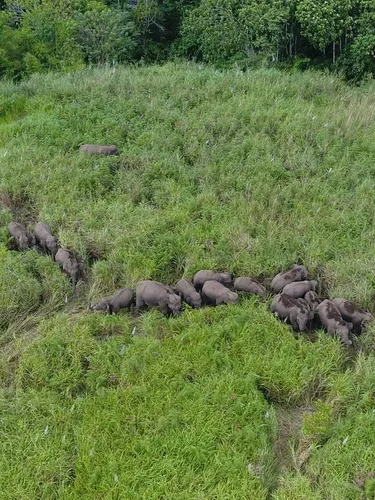
© Mahmud Yani / WWF-Indonesia
Sumatran elephants
Sumatran elephants feed on a variety of plants and deposit seeds wherever they go, contributing to a healthy forest ecosystem. They also share their lush forest habitat with several other endangered species, such as the Sumatran rhino, tiger, and orangutan, and countless other species that all benefit from an elephant population that thrives in a healthy habitat.
Sumatran elephant facts
- Status Learn more about endangered status categories and explanation
- Critically endangered
- Population
- 2,400–2,800
- Scientific name
- Elephas maximus sumatranus
- Weight
- approximately 5 tons
- Height
- 5–9 feet at the shoulder
- Length
- up to 20 feet
- Habitats
- Broadleaf moist tropical forests
Why Sumatran elephants matter
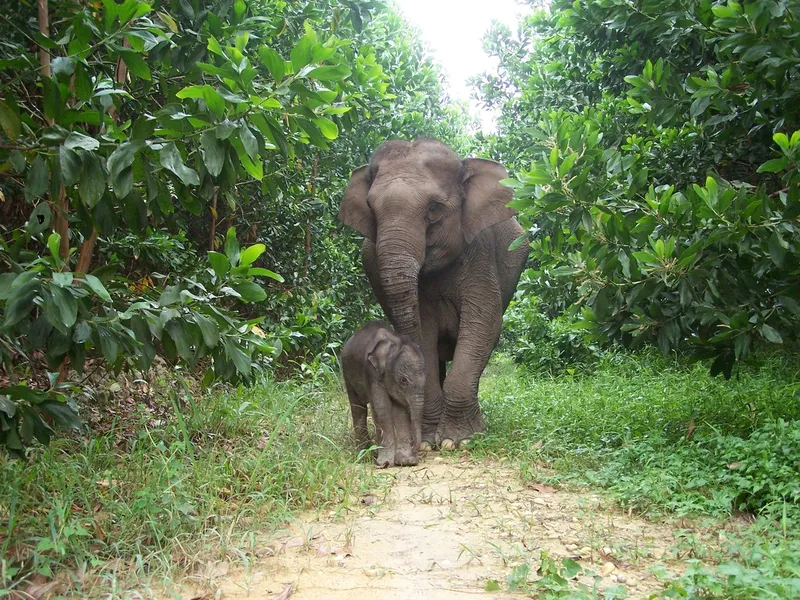
© WWF-Indonesia
Sumatran elephants feed on a variety of plants and deposit seeds wherever they go, contributing to a healthy forest ecosystem.
Threats to Sumatran elephants
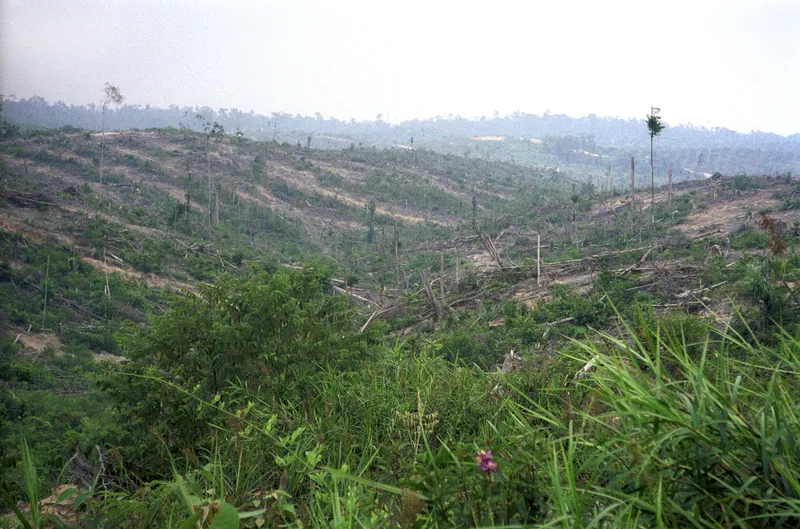
Deforestation and habitat loss
In 2012, the Sumatran elephant was changed from “Endangered” to “Critically Endangered” because half of its population has been lost in one generation—a decline that is largely due to habitat loss and as a result human-elephant conflict. Sumatra has experienced one of the highest rates of deforestation within the Asian elephant’s range, which has resulted in local extinctions of elephants in many areas. Over two-thirds of its natural lowland forest has been razed in the past 25 years and nearly 70 percent of the Sumatran elephant’s habitat has been destroyed in one generation.
In Sumatra’s Riau province, pulp and paper industries and oil palm plantations have caused some of the world’s most rapid rates of deforestation. Elephant numbers have declined by a staggering 80 percent in less than 25 years, confining some herds to small forest patches. These populations are not likely to survive in the long-term. The Lampung province has seen its number of elephant herds decline from twelve in the 1980s to only three by 2002. Just two of the remaining herds are considered biologically viable.
© WWF-Germany/A. Vedder
Human-elephant conflict
As a result of the rapid development and deforestation in Sumatra, elephants often come into contact with human settlements. They raid crops, trample homes and sometimes even hurt or kill people. Those affected sometimes retaliate and poison or shoot elephants.
Poaching
Sumatran elephants typically have smaller tusks but they are enough to tempt poachers who kill the animals and sell their tusks on the illegal ivory market. Only male Asian elephants have tusks so every poaching event further skews the sex ratio further constraining breeding rates for the species.
How WWF is taking action to protect Sumatran elephants

© WWF-Indonesia/Samsul Komar
Reducing human-elephant conflict
The region around Tesso Nilo in central Sumatra is being cleared so rapidly that elephants often go to farms and commercial plantations in search of food. In 2004, WWF started an Elephant Flying Squad, which is made up of rangers, noise and light-making devices, a truck, and four trained elephants that would drive wild elephants back into the forests if they threatened to enter villages.
WWF recruited trainers and elephants from elephant camps that the Indonesian government maintains. These nine men and four elephants went through intensive training to create bonds to make them an effective team that safely drives back wild elephants. The project proved so effective in reducing losses suffered by local communities and companies that there are now four flying squads in the Riau Province. WWF runs one of them and the others are run by companies operating in the area and by Tesso Nilo National Park.
The squads help bring short-term relief to the intense conflict between people and elephants and to create support for elephant conservation among struggling communities. WWF carries out research on elephants and the nature of their conflicts with humans and works with local communities and companies to develop solutions that ensure that there is space for humans and elephants to coexist.
Securing healthy forests
A major breakthrough was achieved in Sumatra with the 2004 declaration of Tesso Nilo National Park, a protected area, which represents a significant step towards the protection of the elephant's habitat. The Tesso Nilo forest is one of the last forest blocks large enough to support a viable population of critically endangered Sumatran elephants and is also home to the critically endangered Sumatran tiger.
WWF calls on the government of Indonesia, palm oil companies, members of the pulp and paper industry and conservation organizations, to work together to conserve Sumatran elephants, and their unique habitat. Because Sumatra’s trees are rooted in carbon-rich deep peat soil, the high rate of deforestation is also causing high amounts of carbon to be released into the atmosphere, which contributes to climate change.
Halting poaching and stopping trade
In response to high incidents of elephant and tiger poaching in central Sumatra, WWF and its local partners have coordinated wildlife patrol units that conduct antipoaching patrols, confiscate snares and other means of trapping animals, educate local people on the laws in place concerning poaching, and help authorities apprehend criminals. The evidence collected by wildlife patrol units has helped bring known poachers to court. In many Asian countries, WWF works with TRAFFIC, the wildlife trade monitoring network, to reduce the threat that illegal and illicit domestic ivory markets pose to wild elephants.
Experts

How you can help
© WWF-US / WWFGifts
Adopt an Asian elephant
Support WWF’s global efforts to protect wild animals and their habitats and choose from kits with plush and more.